publications
publications in reversed chronological order
2026
- Mechanistic insights from dynamic structural changes of model bacterial cytoplasmic membranes challenged by Gemini surfactant octenidineOliver J. McDowell, Lauren Matthews, Egor A. Bersenev, Charlotte Kenton, Magdalena Wlodek, Najet Mahmoudi, Rebecca J. Fong, Eva M. Perez-Prat, and Wuge H. BriscoeJournal of Colloid and Interface Science, Aug 2026
Octenidine dihydrochloride (OCT) is a Gemini surfactant that is highly potent in bacterial membrane disruptions via a multitude of molecular interactions mediated by its cationic 4-aminopyridinium headgroup and hydrophobic tail and spacer groups. However, the mechanistic details for such interactions remain to be fully understood. Here, structural changes of unilamellar ternary liposomes comprising 1,2-dipalmitoyl-sn-glycero-3-phosphoethanolamine (DPPE), 1,2-dipalmitoyl-sn-glycero-3-phospho-(1′-rac-glycerol) (DPPG) and cardiolipin (CL), mimicking the cytoplasmic membrane of E. coli bacteria, challenged by OCT at different lipid:surfactant molar ratios (50:1–1:1) and different temperatures (25, 40, and 70 °C), have been studied using synchrotron time-resolved stopped flow small-angle X-ray scattering (TR-SAXS), complemented by wide-angle X-ray scattering (WAXS), dynamic light scattering and zeta potential measurements. The high temporal resolution of the scattering data offered insights into the breakdown-reassembly mechanism of liposome disruption, involving initial membrane lysing and subsequent lipid re-assembly into multilamellar stacks, which then collapsed into a condensed multilamellar LαC phase and a cubic Pn3m phase upon heating. Critical comparisons between OCT and Alkyl 8-10-8, a structurally analogous Gemini surfactant differing only with its quaternary ammonium headgroups, revealed further mechanistic insights from subtle differences in the lipid-surfactant structures. Compared to Alkyl 8-10-8, OCT mediated membrane disruption at a lower concentration, perturbing the membrane thickness and altering the membrane gel-to-fluid phase transition temperature, also causing membrane surface charge neutralisation and reversal. These findings shed light on molecular mechanism of OCT-membrane interactions and the role of the OCT headgroup architecture in its antimicrobial efficacy.

2025
-
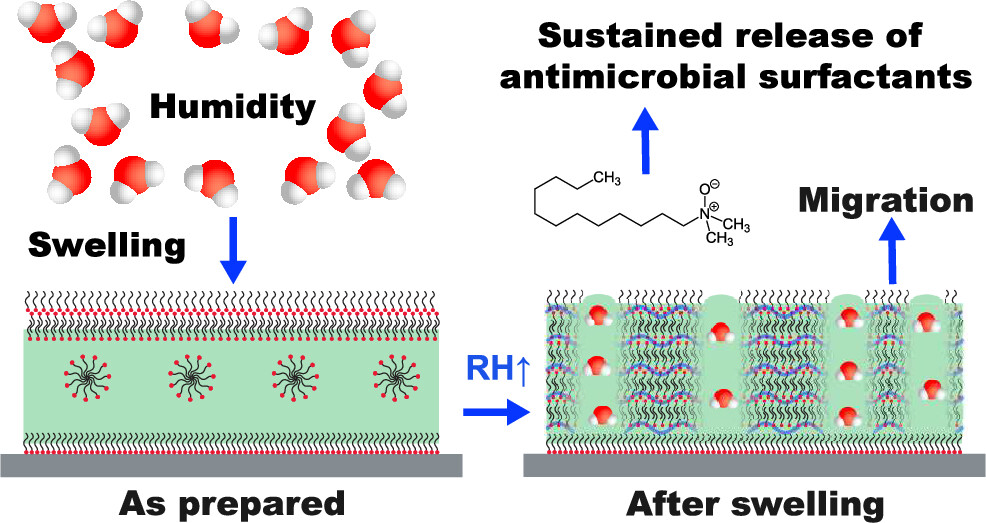 Humidity induced structural transformation in self-organised polymer-surfactant multilayer nanofilmsEgor A. Bersenev, Philipp Gutfreund, Valentina Rein, Andrei Chumakov, Oleg V. Konovalov, and Wuge H. BriscoeLangmuir, Oct 2025
We have investigated the humidity-responsive structure of polymer–surfactant multilayer nanofilms composed of a hydrophilic maleic acid polymer and an amphoteric amine oxide surfactant (C12-AO). Neutron reflectometry (NR) revealed the presence of a smooth thin film comprising several surfactant bilayers intercalated with the polymer. Upon exposure to increased humidity, the nanostructured film reorganized into a vertically stratified multilayer structure with polymer chains located in the vicinity of hydrated surfactant headgroups, with further humidity increase leading to the formation of surfactant-rich domains, indicating a high mobility of the surfactant molecules in the polymer matrix. Off-specular neutron reflectometry and grazing-incidence X-ray scattering revealed the presence of surfactant nanocrystals in the as-prepared film, which diffused to form surfactant-rich domains upon exposure to humidity, thus providing a reservoir of surfactants. These findings help elucidate a mechanism of structural transformation in dried polymer–surfactant films, thus suggesting an avenue for engineering an antimicrobial coating with longevity and a humidity-activated release of active molecules using two-dimensional confinement effects.
-
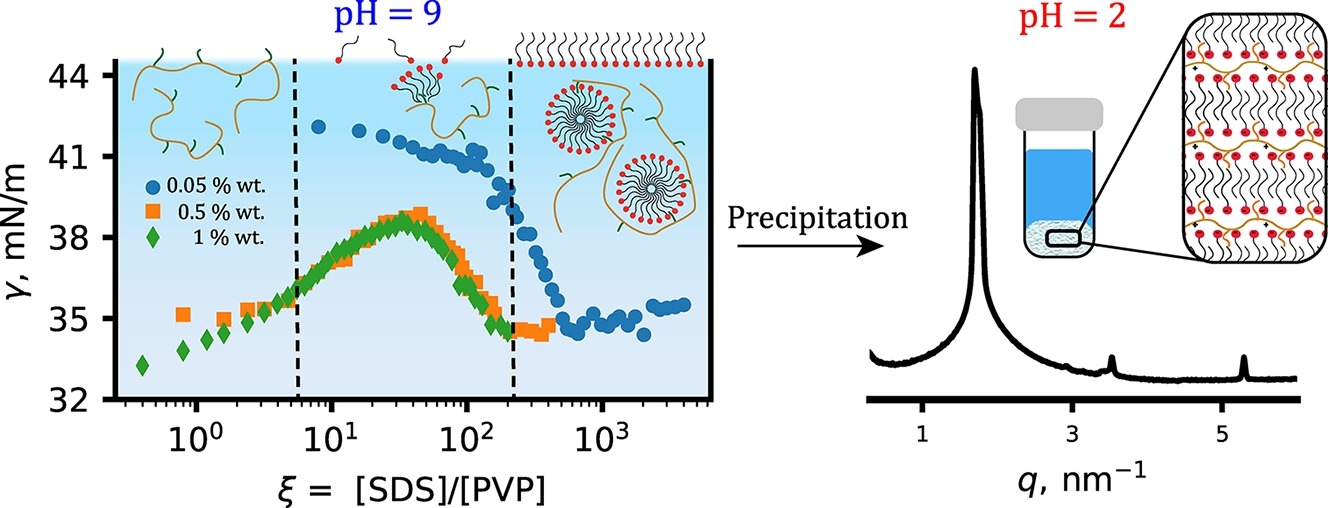 Balance of hydrophobic and electrostatic interaction of polymers and surfactants: Case of anionic surfactant and hydrophobically modified polymerEgor A. Bersenev, Lauren Matthews, Valentina Rein, Rebecca J. Fong, Oleg V. Konovalov, and Wuge H. BriscoeJournal of Colloid and Interface Science, Sep 2025
We investigated the structure of polymer-surfactant aggregates and their pH-dependent structural evolution using hydrophobically modified poly(vinyl-pyrrolidone) (h-PVP) and sodium dodecyl sulfate (SDS). The structure of the complexes in the weak (pH ≃ 9) and strong (pH ≃ 2) interaction regimes was studied using small-angle X-ray scattering, with the data analysed on an absolute intensity scale, using molecular parameters as constraints. At pH 9, where self-assembly was driven by hydrophobic interactions, we have found that, at low surfactant concentrations, elongated aggregates were formed. At excess surfactant concentrations, the aggregates became more compact with a smaller aggregation number, resembling free micelles with the hydrophobic domains of the polymer incorporated into the surfactant core. In all cases, aggregates formed a continuous network, with polymer serving as a weak cross-linker between aggregates. Finally, we have compared the structure of these weakly interacting aggregates with the precipitates formed at low pH, where the electrostatic attraction dominates.

2022
-
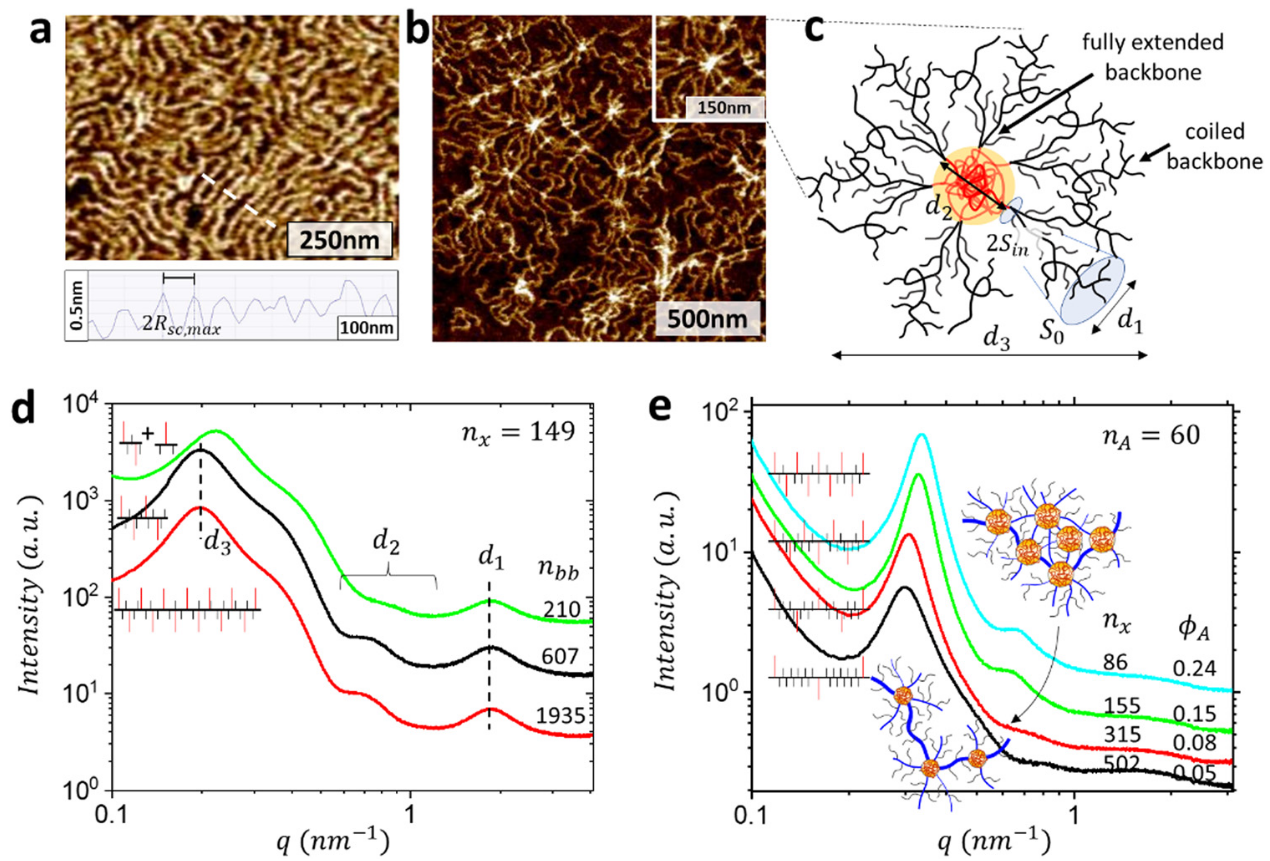 Super-soft, firm, and strong elastomers toward replication of tissue viscoelastic responseErfan Dashtimoghadam, Mitchell Maw, Andrew N. Keith, Foad Vashahi, Verena Kempkes, Yulia D. Gordievskaya, Elena Yu Kramarenko, Egor A. Bersenev, Evgeniia A. Nikitina, Dimitri A. Ivanov, Yuan Tian, Andrey V. Dobrynin, Mohammad Vatankhah-Varnosfaderani, and Sergei S. SheikoMaterials Horizons, Nov 2022Publisher: The Royal Society of Chemistry
Polymeric networks are commonly used for various biomedical applications, from reconstructive surgery to wearable electronics. Some materials may be soft, firm, strong, or damping however, implementing all four properties into a single material to replicate the mechanical properties of tissue has been inaccessible. Herein, we present the A-g-B brush-like graft copolymer platform as a framework for fabrication of materials with independently tunable softness and firmness, capable of reaching a strength of ∼10 MPa on par with stress-supporting tissues such as blood vessel, muscle, and skin. These properties are maintained by architectural control, therefore diverse mechanical phenotypes are attainable for a variety of different chemistries. Utilizing this attribute, we demonstrate the capability of the A-g-B platform to enhance specific characteristics such as tackiness, damping, and moldability.
-
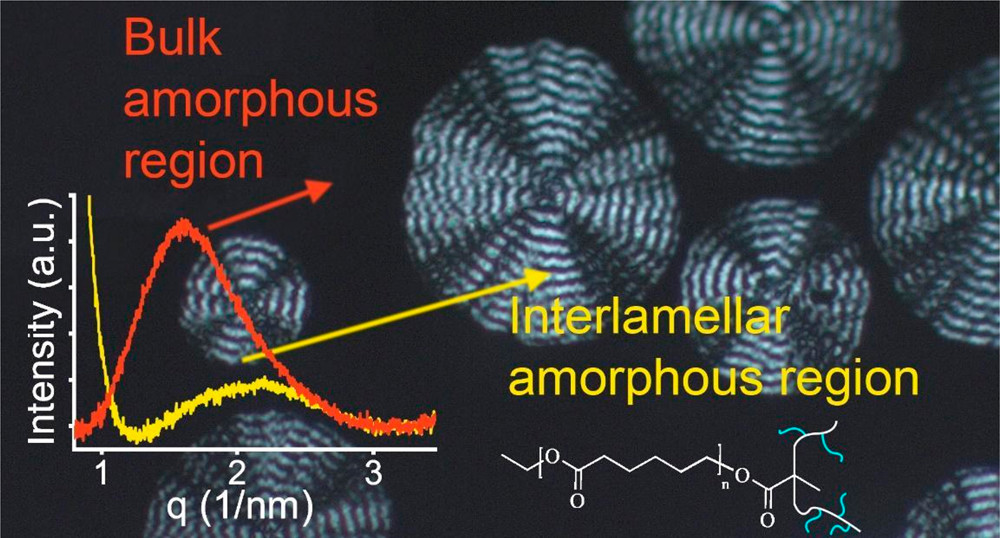 Bottlebrush Elastomers with Crystallizable Side Chains: Monitoring Configuration of Polymer Backbones in the Amorphous Regions during CrystallizationEgor A. Bersenev, Evgeniia A. Nikitina, Erfan Dashtimoghadam, Sergei S. Sheiko, and Dimitri A. IvanovACS Macro Letters, Sep 2022Publisher: American Chemical Society
Brush-like elastomers with crystallizable side chains hold promise for biomedical applications requiring the presence of two distinct mechanical states below and above body temperature: hard and supersoft. The hard semicrystalline state facilitates piercing of the body whereupon the material softens to match the mechanics of surrounding soft tissue. To understand the transition between the two states, the crystallization process was studied with synchrotron X-ray scattering for a series of brush elastomers with poly(ε-caprolactone) side chains bearing from 7 to 13 repeat units. The so-called bottlebrush correlation peak was used to monitor configuration of bottlebrush backbones in the amorphous regions during the crystallization process. In the course of crystallization, the backbones are expelled into the interlamellar amorphous gaps, which is accompanied by their conformational changes and leads to partitioning to unconfined (melt) and confined (semicrystalline) (conformational) states. The crystallization process starts by consumption of the unconfined macromolecules by the growing crystals followed by reconfiguration of macromolecules within the already grown spherulites.
-
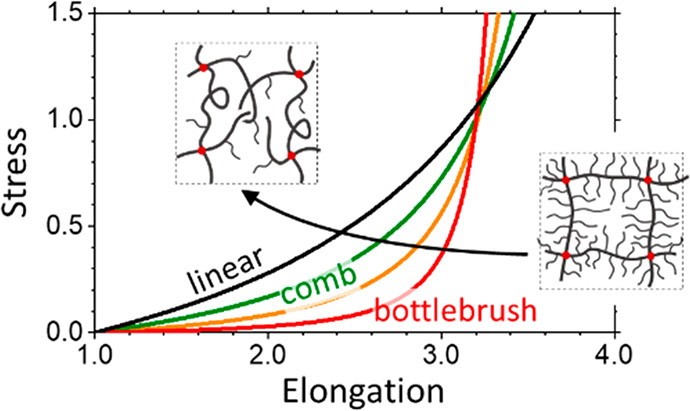 Brush Architecture and Network Elasticity: Path to the Design of Mechanically Diverse ElastomersMitchell Maw, Benjamin J. Morgan, Erfan Dashtimoghadam, Yuan Tian, Egor A. Bersenev, Alina V. Maryasevskaya, Dimitri A. Ivanov, Krzysztof Matyjaszewski, Andrey V. Dobrynin, and Sergei S. SheikoMacromolecules, Apr 2022Publisher: American Chemical Society
We unveil universal correlations between architectural parameters and nonlinear elastic properties of brush polymer networks. A comprehensive library of poly(n-butyl acrylate), poly(dimethylsiloxane), and polyisobutylene brush networks was synthesized with systematically varied side chain length (∼nsc), grafting density (∼ng–1), and backbone degree of polymerization between cross-links (nx). This allowed experimental verification of theoretical scaling relationships between mechanical properties (shear modulus and strain-stiffening), architectural parameters [nsc, ng, nx], and microstructure from in situ small-angle X-ray scattering in both comb and bottlebrush conformational regimes. These results can be used as a foundation for the programmable design of mechanically diverse solvent-free elastic materials.
-
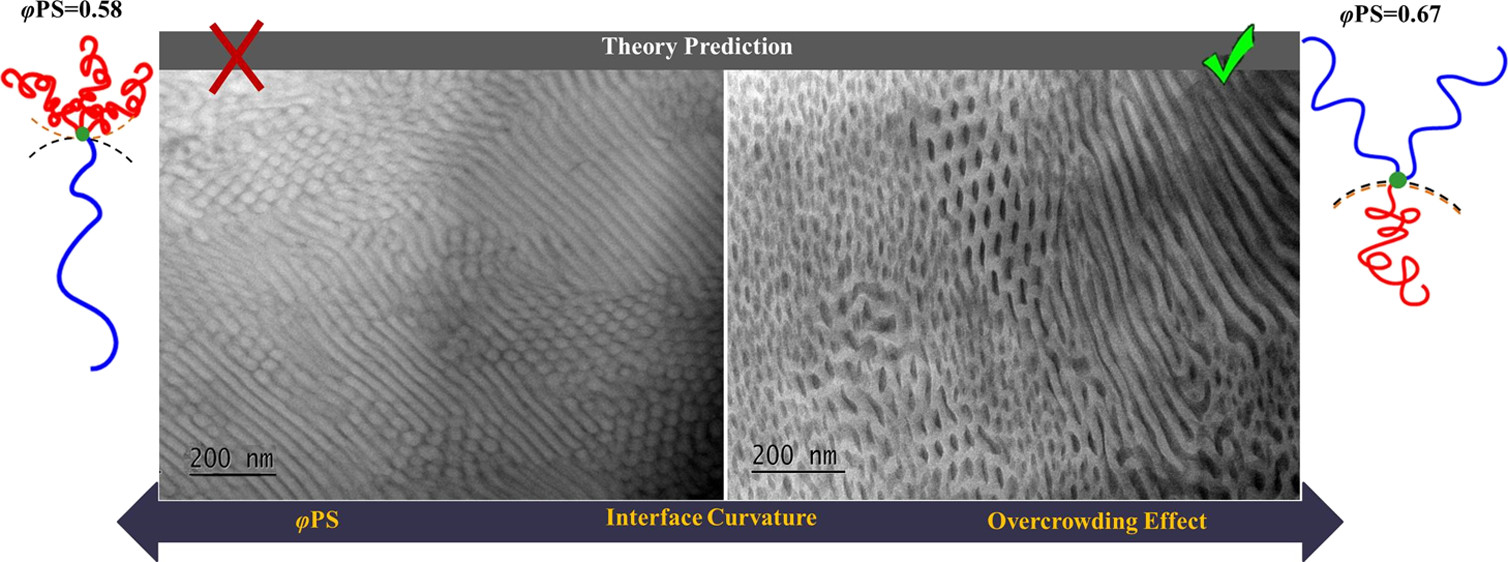 Synthesis, Molecular Characterization, and Phase Behavior of Miktoarm Star Copolymers of the ABn and AnB (n = 2 or 3) Sequences, Where A Is Polystyrene and B Is Poly(dimethylsiloxane)George Liontos, Gkreti-Maria Manesi, Ioannis Moutsios, Dimitrios Moschovas, Alexey A. Piryazev, Egor A. Bersenev, Dimitri A. Ivanov, and Apostolos AvgeropoulosMacromolecules, Jan 2022Publisher: American Chemical Society
Novel miktoarm star copolymers of polystyrene[poly(dimethylsiloxane)n] or PS(PDMS)n (n = 2 or 3) type as well as of the inversed sequence, namely, (polystyrene)n[poly(dimethylsiloxane)] or (PS)nPDMS (n = 2 or 3), were synthesized by combining living anionic polymerization with chlorosilane chemistry. The miktoarm star copolymers were extensively characterized through size exclusion chromatography, vapor pressure/membrane osmometry, proton nuclear magnetic resonance, and differential scanning calorimetry, in order to verify the successful synthesis. All samples with varying volume fractions and narrow dispersity indices (D̵ \textless 1.1) were morphologically characterized by transmission electron microscopy and small-angle X-ray scattering, in order to study their self-assembly behavior as well as to examine the effect of the complex architecture on the final adopted morphologies. For specific PS(PDMS)n (n = 2 or 3), morphologies different from those expected from theoretical predictions (self-consistent field theory or Gaussian statistics) were obtained, while for the inversed sequences, namely, (PS)nPDMS (n = 2 or 3), no discrepancies were evident. This fact further confirmed the impact of the number of arms as well as the flexibility of the segments (PS being stiffer than PDMS) on the structure/property relationship.
- Injectable bottlebrush hydrogels with tissue-mimetic mechanical propertiesFoad Vashahi, Michael R. Martinez, Erfan Dashtimoghadam, Farahnaz Fahimipour, Andrew N. Keith, Egor A. Bersenev, Dimitri A. Ivanov, Ekaterina B. Zhulina, Pavel Popryadukhin, Krzysztof Matyjaszewski, Mohammad Vatankhah-Varnosfaderani, and Sergei S. SheikoScience Advances, 2022
Injectable hydrogels are desired in many biomedical applications due to their minimally invasive deployment to the body and their ability to introduce drugs. However, current injectables suffer from mechanical mismatch with tissue, fragility, water expulsion, and high viscosity. To address these issues, we design brush-like macromolecules that concurrently provide softness, firmness, strength, fluidity, and swellability. The synthesized linear-bottlebrush-linear (LBL) copolymers facilitate improved injectability as the compact conformation of bottlebrush blocks results in low solution viscosity, while the thermoresponsive linear blocks permit prompt gelation at 37°C. The resulting hydrogels mimic the deformation response of supersoft tissues such as adipose and brain while withstanding deformations of 700% and precluding water expulsion upon gelation. Given their low cytotoxicity and mild inflammation in vivo, the developed materials will have vital implications for reconstructive surgery, tissue engineering, and drug delivery applications. Minimally invasive injection yields robust hydrogels that mimic the mechanics and water fraction of surrounding tissue.


2021
- Molecular patterns of oligopeptide hydrocarbons on graphiteNikolay A. Barinov, Anna P. Tolstova, Egor A. Bersenev, Dmitry A. Ivanov, Evgeniy V. Dubrovin, and Dmitry V. KlinovColloids and Surfaces B: Biointerfaces, Oct 2021
Graphitic materials including graphene, carbon nanotubes and fullerenes, are promising for use in nanotechnology and biomedicine. Non-covalent functionalization by peptides and other organic molecules allows changing the properties of graphitic surfaces in a controlled manner and represents a big potential for fundamental research and applications. Recently described oligopeptide-hydrocarbon derivative N,N’-(decane-1,10-diyl)bis(tetraglycineamide) (GM) is highly prospective for the development of graphitic interfaces in biosensor application as well as in structural biology for improving the quality of high-resolution atomic force microscopy (AFM) visualization of individual biomacromolecules. However, molecular organization of GM on graphitic surfaces is still unknown. In this work, the molecular model of GM at the water/highly oriented pyrolytic graphite (HOPG) interface has been developed basing on the high-resolution AFM and full-atom molecular modeling data. This model explains two periodicities observed in AFM images by GM self-assembly on a HOPG surface with formation of the stacks with the lateral shifts. The obtained results reveal the particular patterns and dynamics of GM molecules adsorbed on graphite and unravel the puzzle of peptide self-assembly on graphitic surfaces.
-
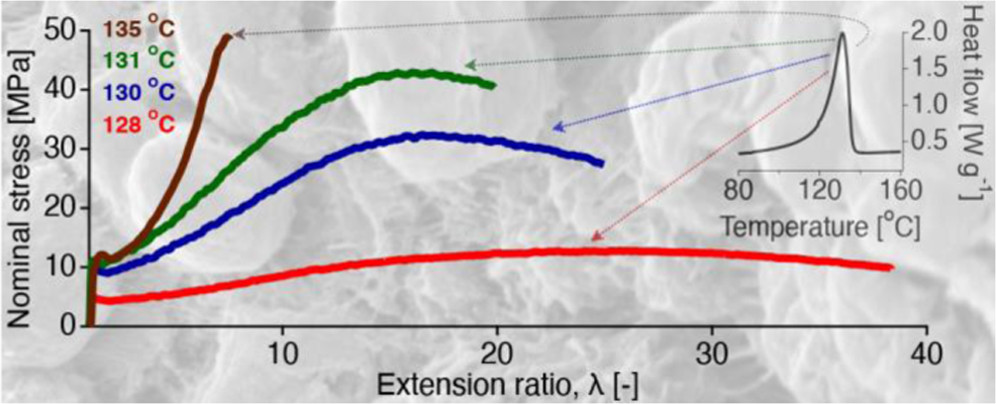 Melting-Induced Evolution of Morphology, Entanglement Density, and Ultradrawability of Solution-Crystallized Ultrahigh-Molecular-Weight PolyethyleneFotis Christakopoulos, Egor Bersenev, Souren Grigorian, André Brem, Dimitri A. Ivanov, Theo A. Tervoort, and Victor LitvinovMacromolecules, Jun 2021Publisher: American Chemical Society
The melting-induced change in the density of physical network junctions, which are formed by chain entanglements and network junctions due to anchoring of chain segments to crystals, is studied by 1H NMR T2 relaxometry for solution- and melt-crystallized ultrahigh-molecular-weight polyethylene (UHMWPE), sc-UH, and mc-UH, respectively. The NMR results are complemented by real-time synchrotron wide- and small-angle X-ray scattering (WAXS and SAXS) analyses to extract the sizes of the crystalline lamellae and intercrystalline domains. Below the melting temperature, the network of physical junctions is denser in the amorphous phase of mc-UH than the one in sc-UH owing to a lower entanglement density and a smaller number of physical junctions from polymer crystals in sc-UH. However, the difference in the total density of physical junctions between mc-UH and sc-UH films decreases with decreasing crystallinity during melting. At the end of the melting trajectory, at vanishing crystallinity, the volume-average entanglement density, as characterized by the NMR method, is approximately the same in sc- and mc-UH. This indicates that the entanglement density in sc-UH films increases during melting owing to the fast buildup of local chain entanglements. These entanglements are formed by segments of the same chain, neighboring chains, or both due to a displacement of chain fragments upon lamellar thickening and due to the so-called “chain explosion” that occurs locally in the amorphous domains. The increase in the entanglement density in sc-UH is additionally confirmed by the solid-state drawability of sc-UH films that were annealed in the melting region but below the end of melting. The maximum draw ratio decreases and the drawing stress increases with the increasing annealing temperature.

2020
- Self-Assembly of Low-Molecular-Weight Asymmetric Linear Triblock Terpolymers: How Low Can We Go?Christina Miskaki, Ioannis Moutsios, Gkreti-Maria Manesi, Konstantinos Artopoiadis, Cheng-Yen Chang, Egor A. Bersenev, Dimitrios Moschovas, Dimitri A. Ivanov, Rong-Ming Ho, and Apostolos AvgeropoulosMolecules, Jan 2020Number: 23 Publisher: Multidisciplinary Digital Publishing Institute
The synthesis of two (2) novel triblock terpolymers of the ABC type and one (1) of the BAC type, where A, B and C are chemically different segments, such as polystyrene (PS), poly(butadiene) (PB1,4) and poly(dimethylsiloxane) (PDMS), is reported; moreover, their corresponding molecular and bulk characterizations were performed. Very low dimensions are evident from the characterization in bulk from transmission electron microscopy studies, verified by small-angle X-ray data, since sub-16 nm domains are evident in all three cases. The self-assembly results justify the assumptions that the high Flory–Huggins parameter, χ, even in low molecular weights, leads to significantly well-ordered structures, despite the complexity of the systems studied. Furthermore, it is the first time that a structure/properties relationship was studied for such systems in bulk, potentially leading to prominent applications in nanotechnology and nanopatterning, for as low as sub-10 nm thin-film manipulations.
- Tissue-Adaptive Materials with Independently Regulated Modulus and Transition TemperatureDaixuan Zhang, Erfan Dashtimoghadam, Farahnaz Fahimipour, Xiaobo Hu, Qiaoxi Li, Egor A. Bersenev, Dimitri A. Ivanov, Mohammad Vatankhah-Varnoosfaderani, and Sergei S. SheikoAdvanced Materials, 2020
The ability of living species to transition between rigid and flexible shapes represents one of their survival mechanisms, which has been adopted by various human technologies. Such transition is especially desired in medical devices as rigidity facilitates the implantation process, while flexibility and softness favor biocompatibility with surrounding tissue. Traditional thermoplastics cannot match soft tissue mechanics, while gels leach into the body and alter their properties over time. Here, a single-component system with an unprecedented drop of Young’s modulus by up to six orders of magnitude from the GPa to kPa level at a controlled temperature within 28–43 °C is demonstrated. This approach is based on brush-like polymer networks with crystallizable side chains, e.g., poly(valerolactone), affording independent control of melting temperature and Young’s modulus by concurrently altering side chain length and crosslink density. Softening down to the tissue level at the physiological temperature allows the design of tissue-adaptive implants that can be inserted as rigid devices followed by matching the surrounding tissue mechanics at body temperature. This transition also enables thermally triggered release of embedded drugs for anti-inflammatory treatment.
- Independently Tuning Elastomer Softness and Firmness by Incorporating Side Chain Mixtures into Bottlebrush Network StrandsAndrew N. Keith, Charles Clair, Abdelaziz Lallam, Egor A. Bersenev, Dimitri A. Ivanov, Yuan Tian, Andrey V. Dobrynin, and Sergei S. SheikoMacromolecules, Nov 2020Publisher: American Chemical Society
Softness and firmness are opposing traits that synergistically define the elastic response of biological systems. Currently, no single class of synthetic materials including elastomers and gels provides independent control of these mechanical characteristics, particularly without altering chemical composition. To address this challenge, we explore a hierarchical bottom-up approach via architectural modulation of bottlebrush mesoblocks followed by their self-assembly into linear–brush–linear triblock copolymer networks. By judiciously incorporating side chains of different lengths, we seamlessly demonstrate full control over elastomer firmness at a fixed Young’s modulus, thus bypassing the infinitely laborious synthesis of targeted side chain lengths. This industrially scalable iteration upon the design-by-architecture approach to network construction delivers thermoplastic elastomers with unprecedented softness–firmness combinations desired in soft robotics, flexible electronics, and biomedical devices.
- Exploring the Complexation of Counterion in Novel Family of Polyelectrolytes with Unexpected Solubility BehaviourEgor A. Bersenev, Alina Maryasevskaya, Evgenii V. Komov, Denis V. Anokhin, and Dimitri A. IvanovKey Engineering Materials, 2020Conference Name: XVI INTERNATIONAL SCIENTIFIC AND PRACTICAL CONFERENCE «NEW POLYMER COMPOSITE MATERIALS» Publisher: Trans Tech Publications Ltd
In the present paper we study the effect of complexation in linear negatively charged polyelectrolytes with different alkali ions. With combination of IR-spectroscopy, X-ray diffraction and nanocalorimetry, we attempted to explain unusual solubility, crystallinity and thermal stability of these polymers. The increase of thermal stability and insolubility in water in series of semi-crystalline polysalts as K+ ≤ H+ <Na+ was explained by effectiveness of formation of chelating complex. Insoluble in water sodium salt shows the highest thermal stability of crystal phase up to . In contrast, well soluble in water amorphous lithium salt does not self-organize in chelating complex and is presented in ionic form.


2019
-
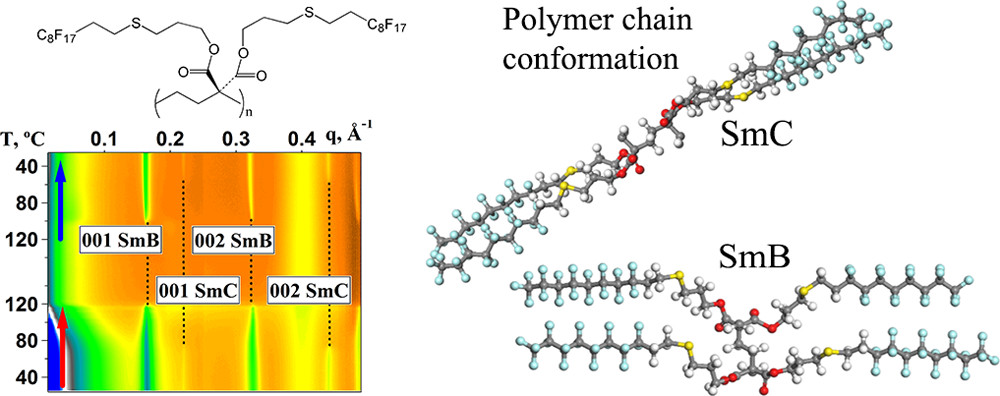 Synthesis and Solid-State Properties of PolyC3 (Co)polymers Containing (CH2–CH2–C(COOR)2) Repeat Units with Densely Packed Fluorocarbon Lateral ChainsNicolas Illy, Deogratias Urayeneza, Alina V. Maryasevskaya, Laurent Michely, Sylvie Boileau, Blandine Brissault, Egor A. Bersenev, Denis V. Anokhin, Dimitri A. Ivanov, and Jacques PenelleMacromolecules, Dec 2019Publisher: American Chemical Society
The synthesis and structural characterization of linear PolyC3 polymers containing trimethylene-1,1-dicarboxylate structural repeat units with C6F13 and C8F17 fluorinated side chains is described for the first time, and their properties were compared with the traditional polyvinyl structures that display the fluorinated chain on every second rather than on every third carbon alongside the backbone. Homopolymers as well as statistical and block copolymers with n-propyl and/or allyl trimethylene-1,1-dicarboxylate blocks have been obtained from PolyC3 precursors containing diallyl trimethylene-1,1-dicarboxylate units, by reacting C6F13–C2H4–SH and C8F17–C2H4–SH thiols with the allyl groups using a thiol–ene post-polymerization modification reaction. Solid-state properties have been investigated by differential scanning calorimetry for all of the (co)polymers and by small-angle X-ray scattering/wide-angle X-ray scattering for the C8F17 homopolymer at several temperatures. The structure of the homopolymer consistently shows a coexistence of two smectic phases at room temperature, which can be identified as SmB and SmC. This coexistence is assumed to arise from the fact that the distances between carboxylic oxygens bonded to the same carbon are very close to the ones between the neighboring carboxylic oxygens alongside the backbone, resulting in two possible ways of packing the pendent fluoroalkyl chains arranged in a hexatic order.
- Synergetic effect of fullerene and graphene oxide nanoparticles on mechanical characteristics of cross-linked polyurethanes under static and dynamic loadingAlexander E Tarasov, Denis V Anokhin, Yana V Propad, Egor A Bersenev, Sergey V Razorenov, Gennady V Garkushin, and Elmira R BadamshinaJournal of Composite Materials, Nov 2019Publisher: SAGE Publications Ltd STM
The effect of low concentration of fullerene, graphene oxide and their combinations at an 85/15 ratio as additives on structure and mechanical properties of cross-linked polyurethanes has been studied at static and dynamic loading. Structure of nanocomposites has been determined from X-ray analysis and scanning electron microscopy. It has been shown that the presence of carbon nanoparticles in a composite results in its lower strength under both static and shock-wave loads. The synergetic effect of carbon nanoparticles mixture is revealed to have 1.25 times higher Young’s modulus as compared with native polymer.

